If you are a graduate researcher, medical professional, software engineer, or STEM student, your weekly workflow revolves around dense academic PDFs: two-column preprints from ArXiv, clinical trials on PubMed, and technical specifications from IEEE or ACM.
Yet opening a 20-page research paper packed with nested clauses, passive syntax, and LaTeX equations often triggers immediate cognitive fatigue. Most readers make the mistake of reading a scientific paper linearly from word one to the bibliography—staring silently at the screen until their attention drifts and they have to re-read the same methodology section four times.
In this guide, you will learn how to combine the battle-tested 3-Pass Method with bimodal neural audio and active vocal recall to digest complex scientific literature twice as fast while keeping every equation, table, and diagram intact.
1. Why Academic Research Papers Exhaust Working Memory
Academic prose is structurally different from standard non-fiction. Even for seasoned researchers, three structural bottlenecks slow down silent reading:
A. Extreme Nominalization (Academic Density)
Scientific writing compresses active processes into heavy noun phrases. Instead of writing “We measured how neurons fire under thermal stress”, a paper states:
“The quantification of neuronal excitation dynamics under elevated thermal regimes revealed statistically significant variance…”
Decoding these packed clauses purely through silent visual scanning overloads the phonological loop in your working memory—one of the primary disadvantages of silent reading.
B. Multi-Column Visual Friction
Two-column PDFs with embedded plots, footnotes, and mathematical proofs force constant eye saccades. For researchers who struggle with focus or need an ADHD guide to reading dense technical PDFs, static PDF viewers offer zero pacing support.
C. The IMRaD Architecture
Nearly every paper follows the Introduction, Methods, Results, and Discussion (IMRaD) structure. Reading each section with the same speed and intensity wastes valuable cognitive energy.
| Paper Section | Strategic Goal | Optimal Active Reading Mode |
|---|---|---|
| Title, Abstract & Figures | Grasp the core hypothesis and empirical contribution | Quick visual scan + high-definition neural audio |
| Introduction & Related Work | Map prior literature and problem framing | Bimodal listening at 1.25x speed (bimodal reading method) |
| Methodology & Proofs | Verify experimental setup, algorithms, and equations | In-place paragraph analysis with original LaTeX layout visible |
| Results & Discussion | Evaluate findings, limitations, and future work | Vocalize key takeaways aloud + written synthesis |
2. The 3-Pass Method Upgraded with Bimodal Audio
Developed by Professor S. Keshav at the University of Waterloo, the Three-Pass Method prevents you from drowning in technical minutiae before you understand the big picture. Here is how to supercharge it with multi-sensory PDF tools:
Pass 1: The Structural Bird’s-Eye Scan (5–10 Minutes)
- Read only the Title, Abstract, section headings, and Conclusion.
- Inspect the primary figures, plots, and result tables without getting bogged down in mathematical derivations.
- Outcome: Within 10 minutes, you know the paper’s core contribution and whether it deserves a deep dive.
Pass 2: Deep Comprehension with Bimodal Neural Audio (25–40 Minutes)
- Dive into the Introduction, Results, and Discussion by turning on PDF audiobook mode or paragraph-by-paragraph neural narration while tracking the text with your eyes.
- Pairing visual reading with natural neural prosody (Dual-Coding) locks your focus onto complex arguments and eliminates line regression.
- If you are reading international primary sources or foreign-language papers, use instant in-place PDF translation and contextual glossaries without leaving the page or breaking formulas.
Pass 3: Critical Reconstruction & Vocal Recall (15 Minutes)
- Imagine you are presenting this paper at tomorrow’s lab meeting, journal club, or technical interview.
- Select 2–3 pivotal paragraphs from the Abstract and Discussion and read them aloud into your microphone.
- Complete a one-sentence written synthesis of the paper’s methodology and limitations to cement long-term retention.
3. Why Vocalizing Research Summaries Doubles Retention
A common misconception in academia is that reading is purely an input activity. However, cognitive neuroscience shows that producing concepts aloud activates motor and auditory cortices, dramatically strengthening memory traces compared to silent highlighting.
Whether you are preparing to defend a dissertation, present a poster at an international conference, or master technical books and STEM PDFs, vocalizing key findings while reading the paper ensures you can articulate the research effortlessly in front of peers.
4. How Readara Streamlines Your Literature Review
Readara was built for researchers, engineers, and graduate students who live inside PDF documents on iPad and iPhone:
- Zero Layout Corruption: Import multi-column papers from ArXiv, PubMed, SSRN, or IEEE with 100% of equations, diagrams, and tables preserved.
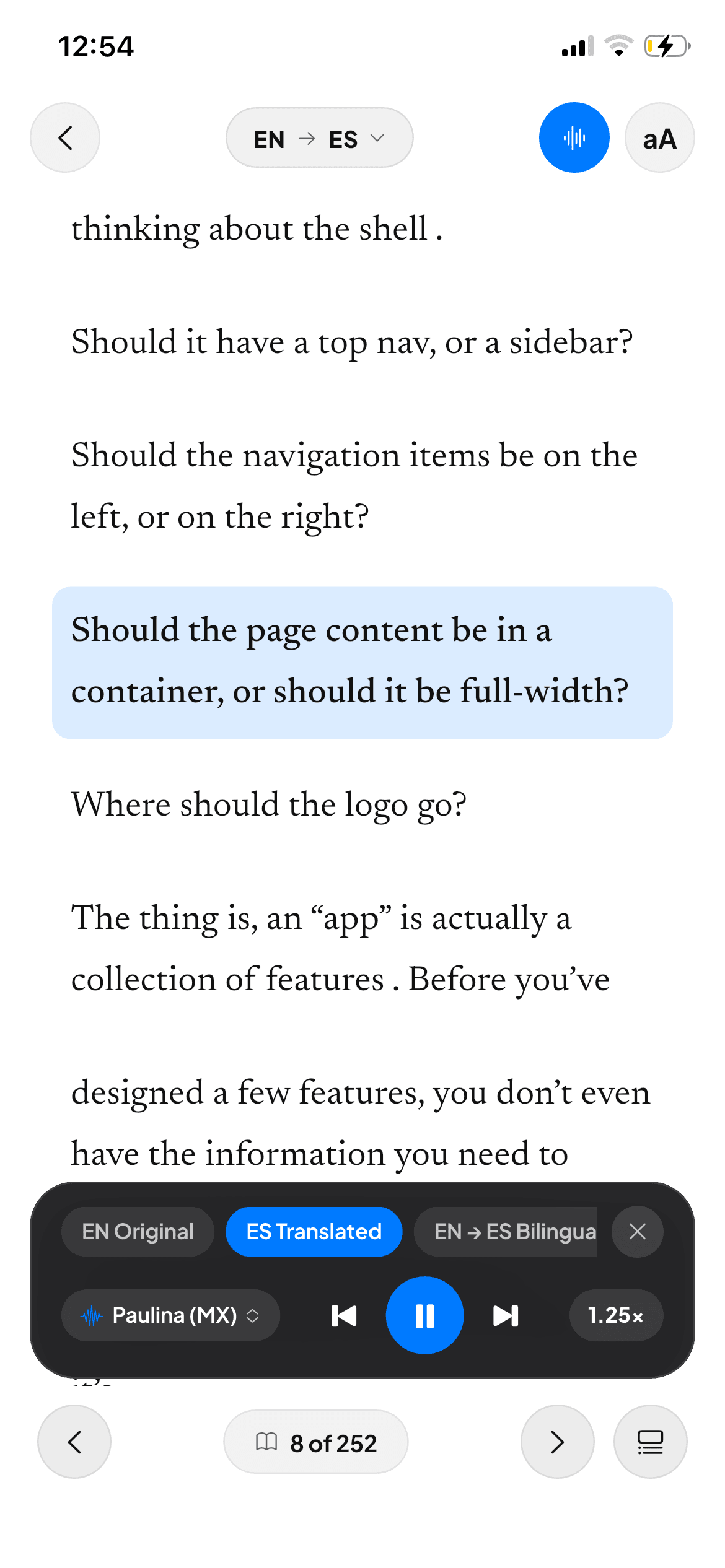
- Paragraph-Aware Neural Audio: Tap any paragraph to hear ultra-natural voice narration without robotic page-number interruptions.
- Contextual Pedagogical Explanations: Decode dense domain terminology or foreign-language citations with a single tap.
- Active Vocal & Written Recall: Practice articulating complex hypotheses aloud with 0–100% speech clarity feedback and interactive summary prompts.
5. Frequently Asked Questions (FAQ)
What is the fastest way to read a scientific paper without missing key details?
Use the 3-Pass Method: spend 5–10 minutes scanning the Abstract, figures, and Conclusion first; then use bimodal reading (visual tracking + neural audio) for the main body; and reserve deep mathematical verification for the final pass.
How can I listen to a two-column research PDF without the audio reading across columns?
Standard screen readers often jumble two-column PDFs or read headers and footers aloud. Readara segments academic pages into clean, logical paragraph blocks so neural narration flows smoothly down each column while keeping the original layout on screen.
Does listening to research papers while reading improve comprehension?
Yes. Dual-coding studies confirm that engaging both visual and auditory channels simultaneously reduces cognitive fatigue on dense academic prose and prevents mind-wandering during long literature reviews.
Conclusion
Reviewing scientific literature does not have to mean hours of silent eye strain. By pairing the 3-Pass Method with bimodal neural audio and active recall in Readara, you can process more papers in less time and retain the insights that drive your research forward.